A recent personal project I’ve been undertaking has been what I’m calling “Doing the OSR in the Third Edition”. The concept is simple, B/X design principles (race as class, incorporating domain based play in the middle levels, a focus on dungeons leading to the wilderness leading to higher level play) but using the mechanics of third edition, which is in my opinion the best edition of the game. So I offer you: The Adventurer Class. I do plan on turning this project into a product currently called Amulet: Second Age when everything is said and done.
In the process of developing the projects that we have going on here at Red Lily Adventuring we came across a problem: How do we make these systems unique and having their own feel while maintaining the feeling that they were developed by the same people? We wanted some sort of “brand identity” for lack of a better word. A specific hook that answers that the question “Why Red Lily Games over game from any other tabletop company?”. (Which is a very good question as a lover of tabletop games in general.)
After a lot of deliberation we came up with an answer: We need a unique dice mechanic/game engine that can be transferable across games while being able to be varied slightly to serve the needs of each game. So we buckled down and blew through dozens of ideas until we settled on what is now the RLA Tabletop Games Engine.
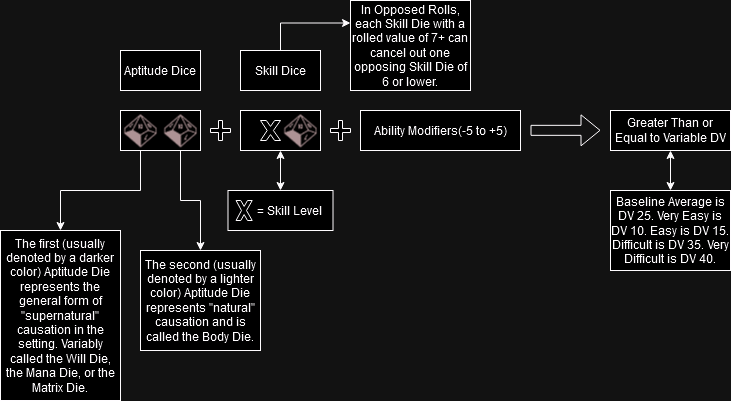
The simple version can be explained as follows: When rolling a Skill Check, the player rolls 2d10 + a number of d10s equal to the Skill Level of the rolled Skill + the appropriate Ability Modifier as determined by the Referee, they are trying to equal or beat a variable Difficulty Value that has been set by the Referee.
The first 2d10 are the Aptitude Dice which consist of the “supernatural” causation die (the Will Die, the Mana Die, the Matrix Die, etc.) and the “natural” causation die (the Body Die). These Aptitude Dice represent the fact that any player character has some level of baseline skill regardless of their level of training in a specific field. The “supernatural” causation die represents the “animating force” that pervades a setting (the net, the quintessence, the spiritus mundi) and the “natural” causation die represents the baseline physical capability of a player character. Rolling 1s and 10s on these dice can have varying effects on the results depending on the specific game system/setting and the specific sort of check (for example a 1 on the Mana Die when rolling to cast a spell could increase a pc’s corruption by demonic forces).
Skill Levels vary from 0 to 5 and denote how many d10 should be rolled as Skill Dice. Ability Modifiers vary from -5 to +5 (we haven’t worked out the underlying scores). We settled on 0 to 5 (no Skill Dice to 5d10 Skill Dice) because the particular curves created by these values mean that we can set the Average DV as 25 and have that remain challenging to middling skill and only really becoming truly trivial when you max out a particular skill (end game characters should feel powerful in their specialties).
Ability modifiers of -5 to +5 allow the system to feel like the Stats have an effect without it being outsized and overshadowing the Skills and powers that the player has chosen to invest time and effort into.
There are a lot of other nuances to the game engine and it will also probably see some minor revisions post playtesting but I have a feeling this core system will remain relatively intact as time progresses. Bloodfall and its weird/dark fantasy super far future pseudo-Renaissance remains our main focus but we have a couple of other projects simmering in the background: a low fantasy truly medieval setting currently codenamed “Mythic Europe” and a cyberpunk/near-future science fiction setting currently codenamed “Net Jockeys/2091. I expect to be able to provide updates on the work usually once a week unless life intervenes.
I love stories. I love writing stories, reading stories, telling stories. I love good movies and good television and good video games and good books. Stories are not why I play tabletop roleplaying games. There are so many other sources for stories and they’re all so much better at telling stories than pen & paper games are. Tabletop games are actually garbage at telling stories. Mind you we have plenty of stories to tell about what we did after playing them but that is not the same thing as the game telling a story.
So why do we play games then? Or I suppose why do I play games? That’s the question I’m going to answer. Then like any good writer I’m just going to assume that I’m completely correct and make sweeping generalizations about the entire medium.
We play games to embody, to go on adventures and inhabit bodies that we cannot in our “real” lives. Whether because of purely physical limitations or those limitations that we impose on ourselves via our ethical principles, we cannot or will not delve into deep dungeons to loot treasure or rescue far trader from space pirates or lead a troop of knights in a gallant lance charge or uncover dark conspiracies of eldritch cultists. That is what games are useful for. We DO things within them. Game systems are the means by which we mediate between ourselves and the world which we are attempting to adventure within.
We can tell stories about our adventures to people after the fact but the game itself has no “story”, it’s not (or at least shouldn’t be) a carefully crafted narrative with characterization and plot nor is it at all similar to improv comedy. It is a much deeper experience than mere narrative. It is an experience of a life other than our own, it is an embodied practice, a ritual that creates new beings and new worlds that we sink into and become. By the sacred words and occult mathematical descriptions hidden within rulebooks we utter into existence new realms and make real the flesh within them.
A game session is therefore not a passive telling but an active doing. Active tense. I swing. I lift. I look. I press my ear to the door. I spit blood from my mouth. Active. Doing. Players are actually solving the mystery, not telling a story about detectives who did it outside of themselves.
Now you may ask yourself, where is this all going? Why does it matter? How can I apply this to my games? Besides my own high-minded ideas about truth and forming the correct theoretical line? I do not have a fucking clue! This is the highest pursuit: ultimately useless speculation based entirely around the personal experiences of a shut-in geek who has read too many books and ran tabletop elf games for more hours than is healthy. Truly, I am the real inheritor of the Socratic tradition!
I haven’t had the opportunity to post in quite a while but work on the Bloodfall Campaign System has been proceeding at quite a steady pace. As such I figured that posting to update y’all on this progress would probably be a good idea. So for anyone new reading this for the first time, let’s answer that pressing question: What is the Bloodfall Campaign System?
What is the Bloodfall Campaign System?
Put simply, the Bloodfall Campaign System is an all-in-one fantasy tabletop roleplaying and miniatures wargaming system. It is a d100 roll under percentile system somewhat in the vein of games like Mythras, Runequest, or Stormbringer but also pulls design influences from classic Rolemaster and TSR era Dungeons & Dragons. The system features a fully playable wargame and a detailed Realms system for the management of player and non-player character domains. The setting of the system, the world of Ereth, is influenced very deeply by the sword & sorcery fiction of the early 20th century (Michael Moorcock, Robert E. Howard, Fritz Leiber, Clark Ashton Smith). Its magic system is based heavily upon historical occult practice from the medieval period and classical antiquity. The enitre system will be released using the Open RPG Creative License (ORC License).
The Actual Production Timeline
The Bloodfall Campaign System Essential Rules (the first release for the system) will be broken down into 4 books and an introductory pamphlet.
Book 2: Of Realms & War Chapter 1: The Realm Chapter 2: The Manor Chapter 3: The Realm Turn Chapter 4: Raising Armies Chapter 5: Campaigning Chapter 6: Intrigue Chapter 7: Human Realms Gazetteer
Book 4: Of Depths & Wilds Chapter 1:Creating Depths Chapter 2: Stocking the Wilderness Map Chapter 3: Weather Chapter 4: Adventure 1 Chapter 5: Adventure 2 Chapter 6: The War of _____ (campaign idea)
The first release will be Book 1: Of Warriors & Wizardry and then we will move onto to Book 3: Of Beastes & Bounty. These will be the only two books that you will need to play the game system as a class fantasy roleplaying game. After this we will decide whether to move to release either Book 2 or Book 4 next. Once all of the books in the Essential Rules are completed they will be released as a bundle and we begin a Kickstarter to be able to release an edition with fully bespoke art.
Supplements and The Future
Once the Essential Rules have been completed we will move on to supporting the game with supplements both for the wargame aspect (Faction Supplements) and the tabletop roleplaying aspect (additional vocations, ancestries, general rules supplements, and adventure modules. We have big plans and many ambitions for the possibilities of the Bloodfall Campaign System and hope that you join us on our journey!
Hey all! I am so bad at posting regularly, I apologize for that! We have been working hard on getting Bloodfall ready to start doing crowdfunding sometime this summer. Probably like late June or Early July. We would like to have the actual rules done by the time we start the Kickstarter so that we can get them in the hands of Backers as soon as the campaign ends. I hope to have a few of the chapters of the final draft finished by next Monday and I will post those then. So short post today, not a lot to say but there’s a lot going on in the background!
Hey y’all it’s been a bit since I’ve posted up on the blog, it’s been a busy two weeks as I’ve been busy painting and haven’t had easy internet access! But anyways, here’s two weeks worth of dungeon rooms!
Area A15: Mushroom Farm
This ruined chapel has been converted into a fungal farm of 10 foot tall mushrooms that the faeries use as a form of solid nutrition. Each mushroom can be broken down into 10 rations worth of food (20 lbs).
Area 16: Guard Room
This simple stone chamber once served as a guard room and armory for the warriors that served in the defense of the priests cloistered here. Some of those warriors (two human warrior skeletons), still stand at their post ready to defend the temple against intruders.
Area A17: Krenshar Nest
Strewn with ruined and chewed wardrobes, a ferocious Krenshar has made its nest in this room after falling down the shaft at the base of the pyramid.
Area A18: Storage Closet
This chamber is lined all the way around with shelves from floor to ceiling. Each of these shelves holds dozens upon dozens of three inch tall, wide-mouthed brown glass bottles. Further inspection of any of the vials will reveal that they are filled to the brim with human teeth.
Area A19: Statuary Hall
Five statues are arranged in a circle in the center of this chamber: one of Hermes, one of Minerva, one of Phosphoros, one of Sofia, and one of Soteria. The statues are all faced outwards, with Hermes facing towards the northern wall, Minerva facing towards the northeastern corner, Phosphoros facing towards the northwestern corner, Sofia facing towards the southeastern corner, and Soteria facing towards the southwestern corner.
Near the western wall, a stirge sucks from the body of a recently deceased adventurer, ready to move onto its next meal.
Area A20: Library
This chamber is a rather well preserved library filled with religious texts and multiple grimoires of Hermetic magic.
Area A21: Guard Room
This simple stone chamber once served as a guard room and armory for the warriors that served in the defense of the priests cloistered here. A spear trap is laid along the southern entrance to this room from the hall leading into it.
Area A22: Statuary Hall
Busts of all 23 High Priests from the Temple’s days of operation are arranged around the perimeter of this dank stone room. A single elf warrior (wounded) is slumped against the western wall next to the door.
Area A23: High Priests’ Crypt
This room contains the sarcophagi the 23 High Priests that held the office while the temple was in operation. Most of them have been broken into and looted already, but five remain untouched. In order, they read in Ancient Elitarian: Porphyrios, 7th Prelate; Galenus, 12th Prelate; Hippon, 18th Prelate; Orestes, 21st Prelate (Decipher Script DC 20)
Treasure: The sarcophagi contain the following grave goods:
Sarcophagus 1: 200 silver pieces, a breastplate engraved with the Eye of Hermes (functions as a helm of teleportation)
Sarcophagus 2: 10 gold pieces, a simple silver ring set with a piece of tiger eye (13 gold pieces), a masterwork shortspear
Sarcophagus 3: 300 silver pieces
Sarcophagus 4: 4,000 copper pieces, 5 iron ingots worth 1 gold piece each (½ lb each), 3 bolts of fine linen worth 10 gold pieces each (4 lbs each)
Sarcophagus 5: 130 gold pieces
Area A24: Forge
This stone room features a large central forge bordered by an anvil and what were once buckets for dousing water. Several bricks have been knocked out of the forge and the leather on the blower has worn way too thin.
Area A25: Torture Chamber
This stone chamber still stinks of blood and feces that must have been discharged by its victims over the thousands of hours of inquisitional torture that was performed here. A single monstrous centipede has decided to take up residence in the ruined torture equipment.
Area A26: Guard Room
This simple stone chamber once served as a guard room and armory for the warriors that served in the defense of the priests cloistered here.
Area A27: Dining Room
The tables and chairs that once furnished this grand dining room lie in a broken mess scattered across the floor. Though once beautiful and well lit, it now stinks of rot. A lone darkmantle has taken up residence on the ceiling in the center of this mess, ready to jump out at any overly curious adventurers.
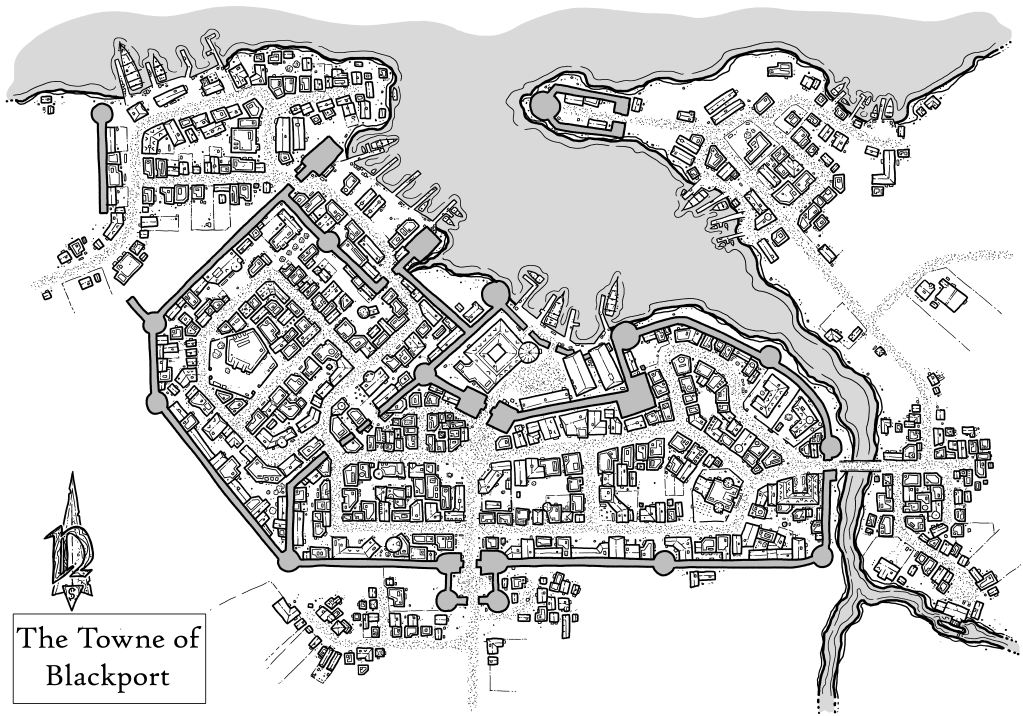
Much like Dungeon23 last year, I am putting out a challenge to myself to create a settlement over the course of the year (I will also be doing a megadungeon this year at the same time). I will be updating these posts every Monday and Friday so I should by the end of the year have a full settlement keyed with 104 total locations. This will be the Towne of Blackport in my Emorean Marches home setting that I’ve been discussing in the Setting Up The Sandbox series. I will by default using 3.5e here but this should be easy to convert into any classic fantasy system.
Blackport is a large town of 4,900 residents and a GP Limit of 3,000 gp. It is ruled by Baron Alaric Blackport (LG Human Fighter 11) though the Baron’s castle & estate are a good 1/2 mile away.
CLASS DEMOGRAPHICS
ADEPTS:
The highest level adept is Father Rathar (CE Human Adept 5) head of the local cult of Ahamara. Under him there are two 2nd level adepts and twenty four 1st level adepts.
ARISTOCRATS:
The highest level aristocrat is Lord-Mayor Litavus Thurk (LN Human Aristocrat 6). Additionally the town has two 3rd level aristocrats and twenty four 1st level aristocrats.
BARBARIANS
The highest level barbarian in town is the Yarma Chieftain Cha’ur (Half-Orc Barbarian 7). She has a townhouse on the street of faces that she stays in. With her are some other barbarians and warriors. Total in the city there are two 3rd level barbarians and four 1st level barbarians in addition to Cha’ur.
BARDS:
The highest level Bard in town is the baron’s court composer Albrecht of Grafenwald (N Human Bard 9). There are in total two 4th level bards, four 2nd level bards, and eight 1st level bards in Blackport.
CLERICS:
The highest level Cleric in town is Bishop Ulrich (LG Human Cleric 9) of the Cathedral of Saint Isolde the Zealot. Serving under the bishop there also two 4th level clerics, four 2nd level clerics, and eight 1st level clerics.
Commoners:
The highest level commoner is town is Erik Eriksson (N Human Commoner 9) the innkeeper of the Bastard’s Chair Inn. Additionally, there are two 4th level commoners, four 2nd level commoners and 4,241 first level commoners.
Experts:
The highest level expert in town is the master blacksmith Eirenaios son of Khabrias (N Human Expert 12). In total there are six journeyman craftspeople in town (two 6th level experts and four 3rd level experts as well as 143 apprentices (1st level experts).
FIGHTERS:
In addition to the Baron, the main fighting force of the town is the knights (two 5 level fighters and four 2nd level fighters) and men-at-arms (eight 1st level fighters) in his service).
MONKS:
The highest level Monk in town is Abbottess Elena (LG Human Monk 6) who is in charge of the cloister adjoined to the Cathedral of Saint Isolde. Within the cloister there are two 3rd level monks and four 1st level monks.
Paladins:
The highest level Paladin in town is Sir Mathias of Oldmead (LG Human Paladin 4) the commander of the Bishop’s Guard. The Guard consists of two 2nd level paladins and four 1st level paladins in addition of Sir Mathias.
Rangers:
The highest level Ranger in town is Warden Alain Redhill (LG Human Ranger 5) the head of the Baron’s Wardens. The Wardens patrol the woods of the Barony in search of poachers and bandits. There are two 2nd level rangers and four 1st level rangers filling out their ranks.
Rogues:
The highest level rogue is Chaptermaster Malaric Sigebertsson (NE Human Rogue 10), head of the local thieves’ guild chapter. The guild consists of six footpads (two 5th level rogues and four 2nd level rogues) and eight apprentices (1st level rogues).
Sorcerers:
The highest level Sorcerer in town is feared daemonologist Isosae (LE Human Sorcerer 7), also known as the Queen of the Underworld. Isosae is head of the local cult of Balam and well known within the criminal element of the town. No one is currently sure exactly where she resides. There are also two 3rd level sorcerers and four 1st level sorcerers in the city.
Warriors:
The highest level warrior in town is captain of the town guard Tiberius Iginius Flavus (LN Human Warrior 10) the town guard also consists of two 5th level warriors, four 2nd level warriors and 238 1st level warriors.
Wizards:
The highest level Wizard in town is Galanthis of Sitia (N Human Wizard 6), the Baron’s court wizard and close advisor. There are also two 3rd level wizards and four 1st level wizards in town.
Friday we will detail the first location will be tavern: The Bastard’s Chair Inn.

 Red Lily Adventuring