A recent personal project I’ve been undertaking has been what I’m calling “Doing the OSR in the Third Edition”. The concept is simple, B/X design principles (race as class, incorporating domain based play in the middle levels, a focus on dungeons leading to the wilderness leading to higher level play) but using the mechanics of third edition, which is in my opinion the best edition of the game. So I offer you: The Adventurer Class. I do plan on turning this project into a product currently called Amulet: Second Age when everything is said and done.
At the end of August, I made a post about an idea for a game engine/dice system. We spent quite a bit of the last month doing pretty extensive playtesting to see if it should replace the d100 based system that we have been developing Bloodfall to work for. After several iterations, we’ve concluded that we are going to be sticking with the d100 hybrid system that we had been developing but we learned a couple of interesting things along the way!
Lesson One: Dice Pools are hard to balance!
It turns out that actually dice pools run into some pretty weird to fix problems pretty quickly. First of all, because of the way that adding even one more die changes the probability curve of a roll trying to create the sense of advancement that we want just doesn’t work super well. This also creates a problem where if you have any two opponents who are of differing skill levels to each other it heavily favors the more skilled opponent to a degree that we found to not give the vibe we wanted out of the game.
Lesson two: Legibility Is very important!
While the system initially sounded great to us while we were writing it, trying to run the thing proved very quickly to be unwieldy in a way that just did not work the way we hoped. There were too many things to keep track of with each roll (especially using a VTT!). Which die was the Body Die again? Which one was the Power Die? How many dice? Plus what?
In order to have a system we feel comfortable putting out for people to play games with we want the basics to be graspable within the first five times you use them. Don’t get me wrong we love systems complexity and crunch but it should not get in the way of understanding the core thing that you’re doing.
Since then we’ve been hard at work designing Bloodfall. I also have a few other things coming down the pipeline soon. I’m working on an article on Social Combat that should be finished later this week or early next. In addition to Bloodfall I’m also working on two smaller games: Hauberk! a standalone wargame for old school fantasy roleplaying games and Amulet: Second Age a game based on the 1974 Rules with all of the Supplements with some concepts ported over from Bloodfall. I hope to have Hauberk! ready to release before the end of the year. I’m also working on some party construction supplements that will be usable with any fantasy roleplaying games whether they be old school or modern.
Also, just a reminder that I do have a Patreon that I will be posting these articles on at least twelve hours before they go up here! It would be easier to post more often with more support, so if you want to see more from me drop a few dollars a month there. Also at some point soon I want to start doing streams while I’m worldbuilding or designing.
In the process of developing the projects that we have going on here at Red Lily Adventuring we came across a problem: How do we make these systems unique and having their own feel while maintaining the feeling that they were developed by the same people? We wanted some sort of “brand identity” for lack of a better word. A specific hook that answers that the question “Why Red Lily Games over game from any other tabletop company?”. (Which is a very good question as a lover of tabletop games in general.)
After a lot of deliberation we came up with an answer: We need a unique dice mechanic/game engine that can be transferable across games while being able to be varied slightly to serve the needs of each game. So we buckled down and blew through dozens of ideas until we settled on what is now the RLA Tabletop Games Engine.
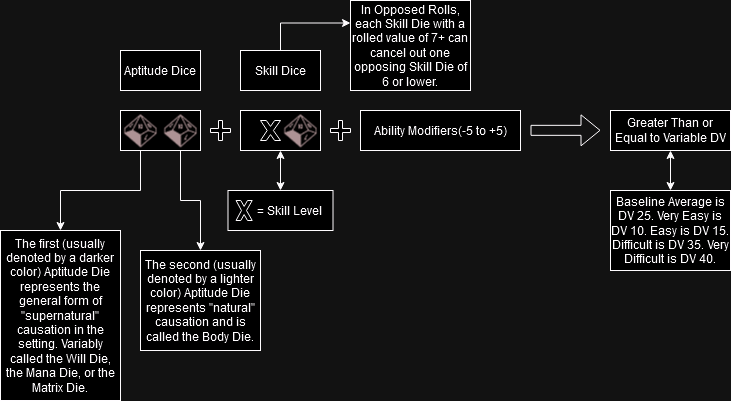
The simple version can be explained as follows: When rolling a Skill Check, the player rolls 2d10 + a number of d10s equal to the Skill Level of the rolled Skill + the appropriate Ability Modifier as determined by the Referee, they are trying to equal or beat a variable Difficulty Value that has been set by the Referee.
The first 2d10 are the Aptitude Dice which consist of the “supernatural” causation die (the Will Die, the Mana Die, the Matrix Die, etc.) and the “natural” causation die (the Body Die). These Aptitude Dice represent the fact that any player character has some level of baseline skill regardless of their level of training in a specific field. The “supernatural” causation die represents the “animating force” that pervades a setting (the net, the quintessence, the spiritus mundi) and the “natural” causation die represents the baseline physical capability of a player character. Rolling 1s and 10s on these dice can have varying effects on the results depending on the specific game system/setting and the specific sort of check (for example a 1 on the Mana Die when rolling to cast a spell could increase a pc’s corruption by demonic forces).
Skill Levels vary from 0 to 5 and denote how many d10 should be rolled as Skill Dice. Ability Modifiers vary from -5 to +5 (we haven’t worked out the underlying scores). We settled on 0 to 5 (no Skill Dice to 5d10 Skill Dice) because the particular curves created by these values mean that we can set the Average DV as 25 and have that remain challenging to middling skill and only really becoming truly trivial when you max out a particular skill (end game characters should feel powerful in their specialties).
Ability modifiers of -5 to +5 allow the system to feel like the Stats have an effect without it being outsized and overshadowing the Skills and powers that the player has chosen to invest time and effort into.
There are a lot of other nuances to the game engine and it will also probably see some minor revisions post playtesting but I have a feeling this core system will remain relatively intact as time progresses. Bloodfall and its weird/dark fantasy super far future pseudo-Renaissance remains our main focus but we have a couple of other projects simmering in the background: a low fantasy truly medieval setting currently codenamed “Mythic Europe” and a cyberpunk/near-future science fiction setting currently codenamed “Net Jockeys/2091. I expect to be able to provide updates on the work usually once a week unless life intervenes.
I love stories. I love writing stories, reading stories, telling stories. I love good movies and good television and good video games and good books. Stories are not why I play tabletop roleplaying games. There are so many other sources for stories and they’re all so much better at telling stories than pen & paper games are. Tabletop games are actually garbage at telling stories. Mind you we have plenty of stories to tell about what we did after playing them but that is not the same thing as the game telling a story.
So why do we play games then? Or I suppose why do I play games? That’s the question I’m going to answer. Then like any good writer I’m just going to assume that I’m completely correct and make sweeping generalizations about the entire medium.
We play games to embody, to go on adventures and inhabit bodies that we cannot in our “real” lives. Whether because of purely physical limitations or those limitations that we impose on ourselves via our ethical principles, we cannot or will not delve into deep dungeons to loot treasure or rescue far trader from space pirates or lead a troop of knights in a gallant lance charge or uncover dark conspiracies of eldritch cultists. That is what games are useful for. We DO things within them. Game systems are the means by which we mediate between ourselves and the world which we are attempting to adventure within.
We can tell stories about our adventures to people after the fact but the game itself has no “story”, it’s not (or at least shouldn’t be) a carefully crafted narrative with characterization and plot nor is it at all similar to improv comedy. It is a much deeper experience than mere narrative. It is an experience of a life other than our own, it is an embodied practice, a ritual that creates new beings and new worlds that we sink into and become. By the sacred words and occult mathematical descriptions hidden within rulebooks we utter into existence new realms and make real the flesh within them.
A game session is therefore not a passive telling but an active doing. Active tense. I swing. I lift. I look. I press my ear to the door. I spit blood from my mouth. Active. Doing. Players are actually solving the mystery, not telling a story about detectives who did it outside of themselves.
Now you may ask yourself, where is this all going? Why does it matter? How can I apply this to my games? Besides my own high-minded ideas about truth and forming the correct theoretical line? I do not have a fucking clue! This is the highest pursuit: ultimately useless speculation based entirely around the personal experiences of a shut-in geek who has read too many books and ran tabletop elf games for more hours than is healthy. Truly, I am the real inheritor of the Socratic tradition!
I haven’t had the opportunity to post in quite a while but work on the Bloodfall Campaign System has been proceeding at quite a steady pace. As such I figured that posting to update y’all on this progress would probably be a good idea. So for anyone new reading this for the first time, let’s answer that pressing question: What is the Bloodfall Campaign System?
What is the Bloodfall Campaign System?
Put simply, the Bloodfall Campaign System is an all-in-one fantasy tabletop roleplaying and miniatures wargaming system. It is a d100 roll under percentile system somewhat in the vein of games like Mythras, Runequest, or Stormbringer but also pulls design influences from classic Rolemaster and TSR era Dungeons & Dragons. The system features a fully playable wargame and a detailed Realms system for the management of player and non-player character domains. The setting of the system, the world of Ereth, is influenced very deeply by the sword & sorcery fiction of the early 20th century (Michael Moorcock, Robert E. Howard, Fritz Leiber, Clark Ashton Smith). Its magic system is based heavily upon historical occult practice from the medieval period and classical antiquity. The enitre system will be released using the Open RPG Creative License (ORC License).
The Actual Production Timeline
The Bloodfall Campaign System Essential Rules (the first release for the system) will be broken down into 4 books and an introductory pamphlet.
Book 2: Of Realms & War Chapter 1: The Realm Chapter 2: The Manor Chapter 3: The Realm Turn Chapter 4: Raising Armies Chapter 5: Campaigning Chapter 6: Intrigue Chapter 7: Human Realms Gazetteer
Book 4: Of Depths & Wilds Chapter 1:Creating Depths Chapter 2: Stocking the Wilderness Map Chapter 3: Weather Chapter 4: Adventure 1 Chapter 5: Adventure 2 Chapter 6: The War of _____ (campaign idea)
The first release will be Book 1: Of Warriors & Wizardry and then we will move onto to Book 3: Of Beastes & Bounty. These will be the only two books that you will need to play the game system as a class fantasy roleplaying game. After this we will decide whether to move to release either Book 2 or Book 4 next. Once all of the books in the Essential Rules are completed they will be released as a bundle and we begin a Kickstarter to be able to release an edition with fully bespoke art.
Supplements and The Future
Once the Essential Rules have been completed we will move on to supporting the game with supplements both for the wargame aspect (Faction Supplements) and the tabletop roleplaying aspect (additional vocations, ancestries, general rules supplements, and adventure modules. We have big plans and many ambitions for the possibilities of the Bloodfall Campaign System and hope that you join us on our journey!
This chamber is beset with a myriad of treasure chests and grave goods that the late king was buried with, many of these have already been looted but a wealth of treasure yet remains
Treasure: 4,000 copper pieces; three fine rugs worth 5 gold pieces each (7 lbs per rug); and a set of full plate
AREA B14: Barren Room
This chamber may have once contained great treasure but has been picked clean over the centuries.
This large chamber was once used to offer up sacrifices and libations to the deified king and his cosmic court. The cracked altar, which is pointed towards the king’s tomb, still smells of the sweet wines that once flowed over its surface.
Monster: Two fiendish dire rats have made their nest behind the altar.
After a couple of day’s absence, I’m excited to get back to posting these (hopefully daily again). I’m excited to post a couple of updates about Bloodfall coming up soon and a few articles that I have in the work about some scenario structures that I’ve been using in my campaigns. We’re a few months out at this point from being ready to launch the Bloodfall kickstarter. I want to have all of the major systems done and a quickstart adventure written before we actually start crowdfunding.
Anyways without further ado here’s the three rooms that I missed posting:
AREA B9: PORTRAIT HALL
This chamber’s walls are line with painted portraits of King Cyaxares I at various points in his life. The paintings eyes all see to follow anyone walking down the hall.
AREA B10: Public Entrance
This small room served as the tomb’s entrance to the public and leads into the mortuary temple where the priests would lead public worship of the deified king.
AREA B11: BArren Room
This simple stone chamber has been picked clean of its former furniture.
This false crypt has a line of closed sarcophagi along the southern wall and a classic pit trap (CR 1; mechanical; location trigger; manual reset; hidden switch bypass (Search DC 25); DC 15 Reflex save avoids; 20 ft. deep (2d6, fall); multiple targets (first target in each of two adjacent 5-ft. squares); Search DC 20; Disable Device DC 23) that is triggered when a PC tries to cross over it to access the sarcophagi it lies in front of.
This massive circular crypt is decorated along the walls and ceiling with paintings depicting the conquests of Cyaxares I, his victories over his enemies, his success in driving Aelaroth into the far north. In each corner stands a 7 foot tall statue of an ancient Elitarian warrior (medium animated object) that has been magically programmed to attack anyone who attempts to open the sarcophagus of the king. The sarcophagus itself sits on a raised dais in the center of the room.
Treasure: The sarcophagus of King Cyaxares I contains 20 platinum pieces, a ceremonial bronze dagger with a red garnet set in the pommel (worth 1,200 gold pieces), and a pair of lesser bracers of archery.



 Red Lily Adventuring