Step 2: Place Rivers
I won’t pontificate for too long on the placement of rivers. It is possibly one of the most discussed subjects in the whole topic of producing maps for fantasy roleplaying games. I will therefore remain concise. It is recommended that you place rivers in ways that make good sense and set them up to flow downhill into larger bodies of water. Lake hexes (bodies of water that take up at least one whole 6 mile hex should have at least two rivers leading into them but feel free to exercise your own judgement.
Step 3: Placing Settlements
Now almost just as much ink has been spilled in the tabletop blogosphere about cities and settlements. The system that I’m about to describe here isn’t necessarily breaking new ground but I am going to be synthesizing several ideas in this system. The main things that I’m drawing upon are Medieval Demographics Made Easy, Traveller’s Universal World Profile, Welsh Piper’s Cities & Settlements article and Medieval Demographics online tool, and this article by Bat in the Attic about using the UWP in a fantasy context.
The Universal City Profile (UCP)
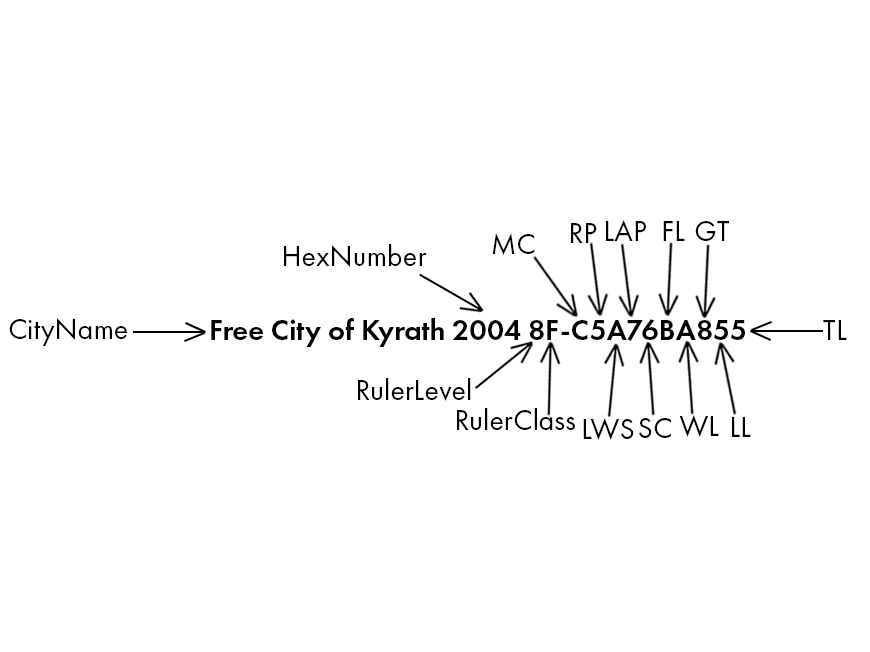
The Universal City Profile, or UCP as I will call it from now on, is an alphanumeric code that is intended to portray a brush over of information on the hex map to make it into a more useful tool for running at the table. The UCP read as follows:
Resource Potential (RP)
The Resource Potential score is determined by rolling 2d6-2 to produce a range of 0-10 (A). This represents how rich in non-agricultural resources the area the settlement is built on is.
Local Water Supply (LWS)
The Local Water Supply score is determined by rolling 2d6-7 and adding or subtracting the appropriate modifiers to produce a range of 0-10 (A). Add +6 if the settlement is within 1 hex of a river. Add +4 if the settlement is within two hexes of a water hex. Add +2 if the settlement is in a forest hex. Subtract -1 if the settlement is in hill hex. Subtract -2 if the settlement is in a mountain hex. Subtract -6 if the settlement is in a desert hex. This value is automatically 10 if the settlement is in a swamp hex.
Local Agricultural Potential (LAP)
The Local Agricultural Potential score is determined by rolling 2d6-7 and adding the Local Water Supply score to produce a range of 0-10 (A). This represents how fertile the farms and herds which are managed immediately outside the settlement and are used to feed the people of the settlement.
Population/Settlement Class (SC)
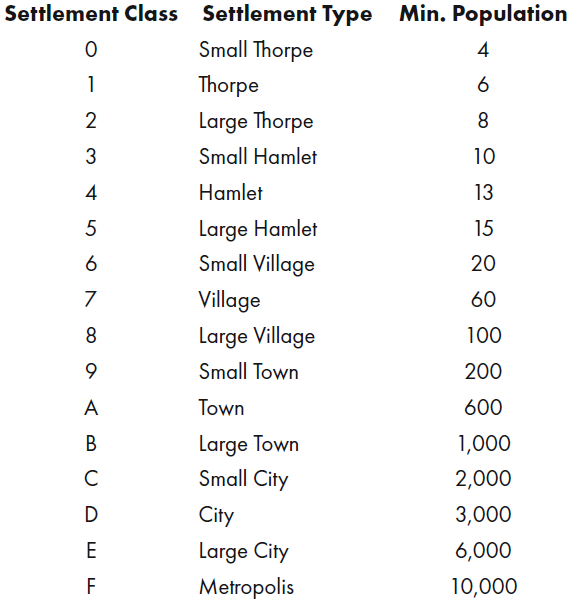
The Settlement Class of a settlement is determined by rolling 2d6 and then adding the appropriate modifiers based on RP, LWS, and LAP, as well as its proximity to other settlements, as detailed below. This will produce a range of between 0 and 15 (F). The minimum population table is in units we will call families, which consists of 5 people.
If the settlement’s RP is 2 or less, subtract one. If the settlement’s LAP is 2 or less subtract one. If the settlement’s LAP is 3, 4, or 5, add one. If the settlement’s LAP is 6 or greater, add three. If the settlement’s LWS is 0, subtract two. If the settlement is adjacent to a settlement with a Settlement Class (SC) of C or higher, subtract six. If the settlement is within two hexes of a settlement with a SC of C or higher, subtract three. If the settlement is adjacent to a settlement with a SC of 9, A, or B, subtract four. If the settlement is within two hexes of a settlement with a SC of 9, A, or B, subtract two. If the settlement is adjacent to a settlement with a SC of 6, 7, or 8, subtract two. If the settlement is within two hexes of a settlement with a SC of 6, 7, or 8, subtract one.
Fortification Level (FL)
This signifies what sort, if any, of fortifications (castles, keeps, etc.), that the ruler of the settlement lives in. This is determined by rolling 2d6 and adding the appropriate modifiers as detailed below.
If the SC of the settlement is C or higher, add six. If the SC of the settlement is 9, A, or B, add four. If the SC of the settlement is 6, 7, or 8, add two. If the SC of the settlement is 3, 4, or 5, subtract two. If the SC of the settlement is 2 or less subtract four.
A score of 12 or higher indicates a FL of A, which means that the settlement contains a full Castle (an internal Keep and surrounding curtain wall). A score of 11 indicates a FL of B, which means that the settlement contains a standalone Keep. A score of 10 indicates a FL of C, which means that the settlement contains a standalone stone Tower. A score of 9 indicates a FL of D, which means that the settlement contains a wooden Hall or Manor House. A score of 8 or less indicates a FL of X, which means that the settlement contains no such fortifications.
Wall Level (WL)
This signifies what sort, if any, of wall or fence encircles and encloses the settlement. This is determined by rolling 2d6 and adding the appropriate modifiers as detailed below.
If the SC of the settlement is C or higher, add six. If the SC of the settlement is 9, A, or B, add four. If the SC of the settlement is 6, 7, or 8, add two. If the SC of the settlement is 3, 4, or 5, subtract two. If the SC of the settlement is 2 or less subtract four.
A score of 12 or higher indicates a WL of A, which means that the settlement has a high stone Curtain Wall. A score of 11 indicates a WL of B, which means that the settlement has a wooden Palisade. A score of 10 indicates a WL of C, which means that the settlement contains a low stone Fence. A score of 9 indicates a WL of D, which means that the settlement has a Hedge. A score of 8 or less indicates a WL of X, which means that the settlement has no such Wall or Fence.
Government Type (GT)
This score indicates what sort of system of government that the settlement operates under. This is determined by rolling 2d6-7 and adding the settlement’s SC.
| Government Type Table | |
| Score | Type |
| 0 | Clan Patriarch/Matriarch |
| 1 | Council of Clan Elders |
| 2 | Aristocratic Oligarchy |
| 3 | Athenian Style Democracy |
| 4 | Temple Complex Rule |
| 5 | Aristocratic Republic |
| 6 | Feudal Noble |
| 7 | Colonial Charter |
| 8 | Bourgeois Republic |
| 9 | Centralized Bureaucratic Republic |
| 10 (A) | Tyrant/Dictator |
| 11 (B) | Petty King |
| 12 (C) | Federation of Freemen’s Guilds |
| 13 (D) | Theocratic Republic |
| 14 (E) | Theocratic Dictatorship/Kingship |
| 15 (F) | Inquisitorial Oligarchy |
Law Level (LL)
The Law Level (LL) of a settlement indicates how much the authority of the ruler interferes with the lives of its inhabitants, what sorts of weapons that PCs can carry in the settlement, and is used as a modifier on certain sorts of checks. It is determined by rolling 2d6-7 and adding the Government Type to produce a range of 0-10 (A).
A LL of between 0-3 means that PCs can carry any sorts of weapons openly in the street. A LL of 4-7 means that PCs can carry swords and daggers but cannot openly carry weapons of war (polearms, spears, hammers, etc). A Law Level of 8 or higher means that PCs may not lawfully carry any weapons other than daggers, which must not be carried openly.
Technology Level (TL)
The Technology Level of a settlement indicates the level of technology that the settlement has access to and produces. For our purposes, this will always be 5, which indicates a level of technology consistent with the period between 1000 CE and 1300 CE.
 Red Lily Adventuring