A recent personal project I’ve been undertaking has been what I’m calling “Doing the OSR in the Third Edition”. The concept is simple, B/X design principles (race as class, incorporating domain based play in the middle levels, a focus on dungeons leading to the wilderness leading to higher level play) but using the mechanics of third edition, which is in my opinion the best edition of the game. So I offer you: The Adventurer Class. I do plan on turning this project into a product currently called Amulet: Second Age when everything is said and done.
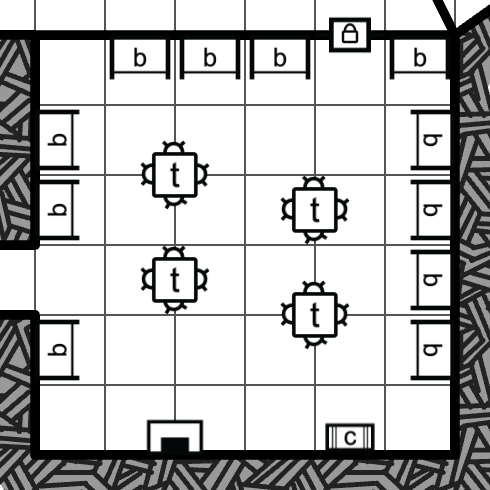
This library of ancient arcane and religious texts is shockingly well preserved. The scroll racks that line the walls are perfectly preserved, only showing the slightest sign of aging at all. The room looks very well traveled through, any PCs that make a DC 10 Spot check will realize that no dust has accumulated on any of the shelves or tables and that there are warm embers in the fireplace. The tables are slightly ink-stained, as if someone had been using them to copy manuscripts in the recent past.
Treasure: In the chest on the southern wall there is 40 platinum pieces and a scroll of color spray. The chest is locked (DC 15 Open Lock) and the lock contains a poison needle trap.
Poison Needle Trap: CR 1; mechanical; touch trigger; manual reset; Atk +8 ranged (1 plus greenblood oil poison [Injury DC 13, Int Dmg: 1 Con, Sec Dmg: 1d2 Con ); Search DC 22; Disable Device DC 20.
Door: Stone (Hardness 8; 60 HP; Break DC 28) Locked (DC 28 Open Lock); the key is in another dungeon room (will update this once that room has been keyed).
I won’t pontificate for too long on the placement of rivers. It is possibly one of the most discussed subjects in the whole topic of producing maps for fantasy roleplaying games. I will therefore remain concise. It is recommended that you place rivers in ways that make good sense and set them up to flow downhill into larger bodies of water. Lake hexes (bodies of water that take up at least one whole 6 mile hex should have at least two rivers leading into them but feel free to exercise your own judgement.
Step 3: Placing Settlements
Now almost just as much ink has been spilled in the tabletop blogosphere about cities and settlements. The system that I’m about to describe here isn’t necessarily breaking new ground but I am going to be synthesizing several ideas in this system. The main things that I’m drawing upon are Medieval Demographics Made Easy, Traveller’s Universal World Profile, Welsh Piper’s Cities & Settlements article and Medieval Demographics online tool, and this article by Bat in the Attic about using the UWP in a fantasy context.
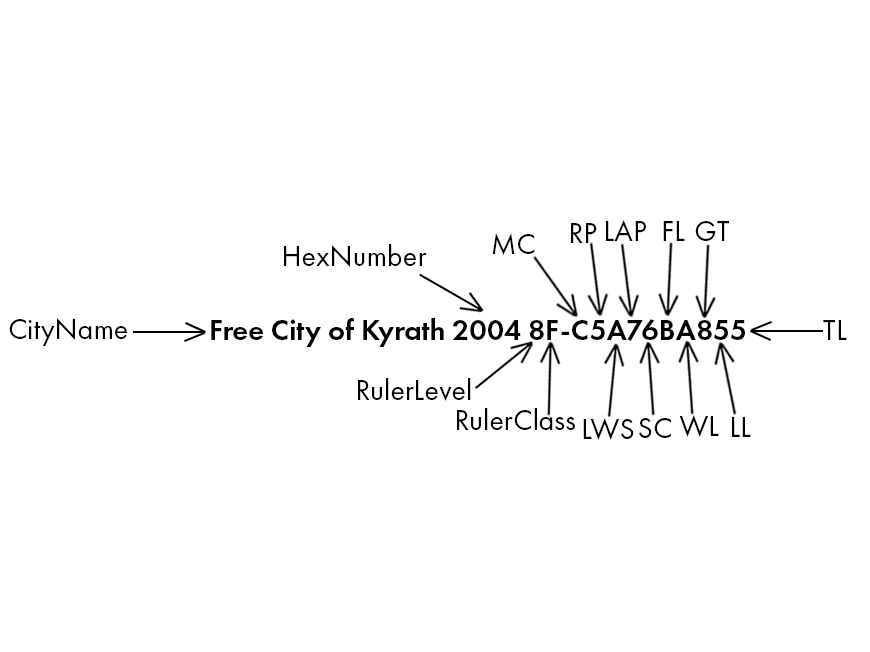
The Universal City Profile (UCP) The Universal City Profile, or UCP as I will call it from now on, is an alphanumeric code that is intended to portray a brush over of information on the hex map to make it into a more useful tool for running at the table. The UCP read as follows:
Resource Potential (RP) The Resource Potential score is determined by rolling 2d6-2 to produce a range of 0-10 (A). This represents how rich in non-agricultural resources the area the settlement is built on is.
Local Water Supply (LWS) The Local Water Supply score is determined by rolling 2d6-7 and adding or subtracting the appropriate modifiers to produce a range of 0-10 (A). Add +6 if the settlement is within 1 hex of a river. Add +4 if the settlement is within two hexes of a water hex. Add +2 if the settlement is in a forest hex. Subtract -1 if the settlement is in hill hex. Subtract -2 if the settlement is in a mountain hex. Subtract -6 if the settlement is in a desert hex. This value is automatically 10 if the settlement is in a swamp hex.
Local Agricultural Potential (LAP) The Local Agricultural Potential score is determined by rolling 2d6-7 and adding the Local Water Supply score to produce a range of 0-10 (A). This represents how fertile the farms and herds which are managed immediately outside the settlement and are used to feed the people of the settlement.
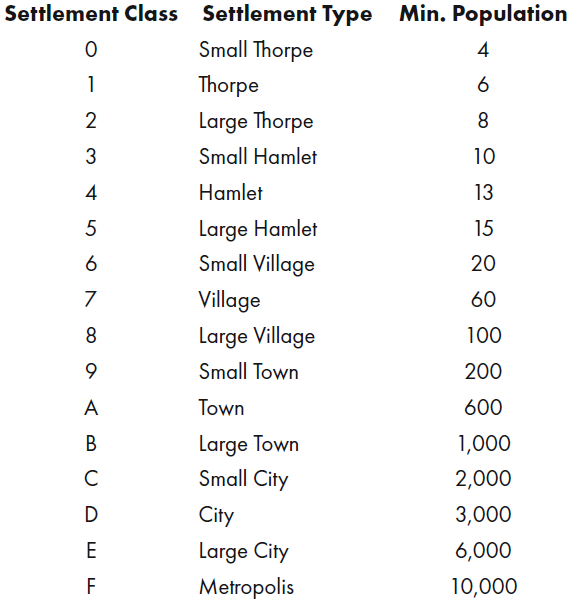
Population/Settlement Class (SC) The Settlement Class of a settlement is determined by rolling 2d6 and then adding the appropriate modifiers based on RP, LWS, and LAP, as well as its proximity to other settlements, as detailed below. This will produce a range of between 0 and 15 (F). The minimum population table is in units we will call families, which consists of 5 people.
If the settlement’s RP is 2 or less, subtract one. If the settlement’s LAP is 2 or less subtract one. If the settlement’s LAP is 3, 4, or 5, add one. If the settlement’s LAP is 6 or greater, add three. If the settlement’s LWS is 0, subtract two. If the settlement is adjacent to a settlement with a Settlement Class (SC) of C or higher, subtract six. If the settlement is within two hexes of a settlement with a SC of C or higher, subtract three. If the settlement is adjacent to a settlement with a SC of 9, A, or B, subtract four. If the settlement is within two hexes of a settlement with a SC of 9, A, or B, subtract two. If the settlement is adjacent to a settlement with a SC of 6, 7, or 8, subtract two. If the settlement is within two hexes of a settlement with a SC of 6, 7, or 8, subtract one.
Fortification Level (FL) This signifies what sort, if any, of fortifications (castles, keeps, etc.), that the ruler of the settlement lives in. This is determined by rolling 2d6 and adding the appropriate modifiers as detailed below.
If the SC of the settlement is C or higher, add six. If the SC of the settlement is 9, A, or B, add four. If the SC of the settlement is 6, 7, or 8, add two. If the SC of the settlement is 3, 4, or 5, subtract two. If the SC of the settlement is 2 or less subtract four.
A score of 12 or higher indicates a FL of A, which means that the settlement contains a full Castle (an internal Keep and surrounding curtain wall). A score of 11 indicates a FL of B, which means that the settlement contains a standalone Keep. A score of 10 indicates a FL of C, which means that the settlement contains a standalone stone Tower. A score of 9 indicates a FL of D, which means that the settlement contains a wooden Hall or Manor House. A score of 8 or less indicates a FL of X, which means that the settlement contains no such fortifications.
Wall Level (WL) This signifies what sort, if any, of wall or fence encircles and encloses the settlement. This is determined by rolling 2d6 and adding the appropriate modifiers as detailed below.
If the SC of the settlement is C or higher, add six. If the SC of the settlement is 9, A, or B, add four. If the SC of the settlement is 6, 7, or 8, add two. If the SC of the settlement is 3, 4, or 5, subtract two. If the SC of the settlement is 2 or less subtract four.
A score of 12 or higher indicates a WL of A, which means that the settlement has a high stone Curtain Wall. A score of 11 indicates a WL of B, which means that the settlement has a wooden Palisade. A score of 10 indicates a WL of C, which means that the settlement contains a low stone Fence. A score of 9 indicates a WL of D, which means that the settlement has a Hedge. A score of 8 or less indicates a WL of X, which means that the settlement has no such Wall or Fence.
Government Type (GT) This score indicates what sort of system of government that the settlement operates under. This is determined by rolling 2d6-7 and adding the settlement’s SC.
Government Type Table
Score
Type
0
Clan Patriarch/Matriarch
1
Council of Clan Elders
2
Aristocratic Oligarchy
3
Athenian Style Democracy
4
Temple Complex Rule
5
Aristocratic Republic
6
Feudal Noble
7
Colonial Charter
8
Bourgeois Republic
9
Centralized Bureaucratic Republic
10 (A)
Tyrant/Dictator
11 (B)
Petty King
12 (C)
Federation of Freemen’s Guilds
13 (D)
Theocratic Republic
14 (E)
Theocratic Dictatorship/Kingship
15 (F)
Inquisitorial Oligarchy
Law Level (LL) The Law Level (LL) of a settlement indicates how much the authority of the ruler interferes with the lives of its inhabitants, what sorts of weapons that PCs can carry in the settlement, and is used as a modifier on certain sorts of checks. It is determined by rolling 2d6-7 and adding the Government Type to produce a range of 0-10 (A).
A LL of between 0-3 means that PCs can carry any sorts of weapons openly in the street. A LL of 4-7 means that PCs can carry swords and daggers but cannot openly carry weapons of war (polearms, spears, hammers, etc). A Law Level of 8 or higher means that PCs may not lawfully carry any weapons other than daggers, which must not be carried openly.
Technology Level (TL) The Technology Level of a settlement indicates the level of technology that the settlement has access to and produces. For our purposes, this will always be 5, which indicates a level of technology consistent with the period between 1000 CE and 1300 CE.
As I’ve been working on Bloodfall and prepping for an old school sandbox campaign that I’m trying to start soon I have become increasingly troubled by the problem of hexmapping and enamored by the old Judges Guild Wilderlands products that I’ve had in my library for years now without much consideration. After a lot of time, consideration, and pursuing both Reddit and every OSR blog I could find, I have devised a very idiosyncratic and probably overly detailed system of creating a hexmap that serves my purposes. I was especially inspired by Welsh Piper’s Hex-based Campaign Design posts, Engine of Oracle’s Random Terrain Tables For Fantasy Hexcrawls, and Bat In The Attic’s How To Make A Fantasy Sandbox. Did the world really need another series of blogposts about hexmap generation? No, it probably doesn’t but alas here we are, for I am cursed with this affliction by the undying forces of Chaos! Hexcrawling and souls for my lord!
In this system hexes have three types: world (30 miles), regional (6 miles), and local (1.2 miles). This gives us world hexes with an area of roughly 780 square miles, regional hexes with an area of roughly 31 square miles, and local hexes with an area of roughly 1 square mile. Each world hex will consist of 19 whole and 12 half regional hexes, (the same goes for the number of local hexes a regional hex contains. If we wanted to go further we could break down the local hexes into an equal amount of roughly quarter mile “subhexes” with an area of roughly 14 hectares but I have seen no general reason to do this as of yet.
To start we will use Template A (found in the zipfile at the end of this post) which is 27 regional hexes wide and 19 regional hexes, giving us a regional area of about 15,903 square miles or a region just a little bit bigger than the country of Montenegro. First, if you wish to have any specific features like an idea for a coastline or a range of mountains place those in their respective areas of the map.
If you don’t have any specific ideas, pick a world hex to start in, I recommend somewhere near the center of the map. You can either choose or randomly determine the dominant elevation and dominant terrain of this starting world hex. If randomly determined the elevation of the starting world hex will be Lowland (1d6-1 times 100 feet, with negative values equaling zero) 60% of the time, Subalpine (1d10+5 times 100 feet) 30% of the time, and Alpine (1d8+1 times 1,000 feet) 10% of the time. Then use the following tables to determine the dominant terrain depending on the dominant elevation.
Lowland World Hex Terrain Table
1d8
Terrain
1
Desert
2
Farmland
3
Marsh/Swamp
4
Plains
5
Heath
6
Deciduous Forest
7
Water
8
Steppe
Subalpine World Hex Terrain Table
1d8
Terrain
1
Badlands
2
Desert
3
Deciduous Forest
4
Bare Hills
5
Forested Hills
6
Moors
7
Coniferous Forest
8
Fen/Bog
Alpine World Hex Terrain Table
1d8
Terrain
1
Bare Mountains
2
Desert
3
Deciduous Forest
4
Forested Mountains
5
Plains
6
Snowcapped Mountains
7
Peatland
8
Coniferous Forest
Now that you have a starting world hex, we need to populate the rest of the world hexes. For each world hex that shares a side with the starting world hex roll 1d100, 50% of the time it will have the same dominant terrain as the starting world hex, 25% of the time it will have a terrain which is considered “secondary” to the starting world hex’s dominant terrain, 17% of the time it will have a terrain that is considered “tertiary” to the starting world hex’s dominant terrain, and 8% of the time it will have a terrain which is considered “quaternary” to the starting world hex’s dominant terrain. Consult the tables below for these types for each dominant terrain.
Badlands (Subalpine) Terrain Types
Type
Terrain
Dominant
Badlands
Secondary
Desert (Subalpine)
Tertiary
Bare Hills
Quaternary
Heath (1-3) or Bare Mountains (4-6)
Bare Hills (Subalpine) Terrain Types
Type
Terrain
Dominant
Bare Hills
Secondary
Bare Mountains
Tertiary
Deciduous Forest (1-3) or Coniferous Forest (4-6)
Quaternary
Desert ( (1-3) or Marsh/Swamp (4-6)
Bare Mountains (Alpine) Terrain Types
Type
Terrain
Dominant
Bare Mountains
Secondary
Bare Hills
Tertiary
Forested Mountains
Quaternary
Desert
Coniferous Forest (Alpine) Terrain Types
Type
Terrain
Dominant
Coniferous Forest (Alpine)
Secondary
Coniferous Forest (Subalpine)
Tertiary
Deciduous Forest (Alpine)
Quaternary
Forested Hills (1-3) or Moors (4-6)
Coniferous Forest (Lowland) Terrain Types
Type
Terrain
Dominant
Coniferous Forest (Lowland)
Secondary
Forested Hills
Tertiary
Deciduous Forest (Lowland)
Quaternary
Marsh/Swamp (1-2), Water (3-5), or Farmland (6)
Coniferous Forest (Subalpine) Terrain Types
Type
Terrain
Dominant
Coniferous Forest (Subalpine)
Secondary
Coniferous Forest (Lowland)
Tertiary
Deciduous Forest (Subalpine)
Quaternary
Forested Hills (1-3) or Moors (4-6)
Deciduous Forest (Alpine) Terrain Types
Type
Terrain
Dominant
Deciduous Forest (Alpine)
Secondary
Deciduous Forest (Subalpine)
Tertiary
Coniferous Forest (Alpine)
Quaternary
Forested Hills (1-3) or Peatland (4-6)
Deciduous Forest (Lowland) Terrain Types
Type
Terrain
Dominant
Deciduous Forest (Lowland)
Secondary
Forested Hills
Tertiary
Coniferous Forest (Lowland)
Quaternary
Marsh/Swamp (1-2), Water (3-5), or Farmland (6)
Deciduous Forest (Subalpine) Terrain Types
Type
Terrain
Dominant
Deciduous Forest (Subalpine)
Secondary
Deciduous Forest (Lowland)
Tertiary
Coniferous Forest (Subalpine)
Quaternary
Forested Hills (1-3) or Moors (4-6)
Desert (Alpine) Terrain Types
Type
Terrain
Dominant
Desert (Alpine)
Secondary
Desert (Subalpine)
Tertiary
Bare Mountains
Quaternary
Bare Hills (1-3) or Farmland (4-6)
Desert (Subalpine) Terrain Types
Type
Terrain
Dominant
Desert (Subalpine)
Secondary
Desert (Lowland)
Tertiary
Bare Hills
Quaternary
Badlands (1-3) or Farmland (4-6)
Farmland (Lowland) Terrain Types
Type
Terrain
Dominant
Farmland
Secondary
Plains
Tertiary
Stepped
Quaternary
Deciduous Forest (1-3) or Coniferous Forest (4-6)
Fen/Bog (Subalpine) Terrain Types
Type
Terrain
Dominant
Fen/Bog
Secondary
Moors
Tertiary
Forested Hills
Quaternary
Heath (1-3) or Water (4-6)
Forested Hills (Subalpine) Terrain Types
Type
Terrain
Dominant
Forested Hills
Secondary
Forested Mountains
Tertiary
Moors
Quaternary
Fen/Bog (1-3) or Peatland (4-6)
Forested Mountains (Alpine) Terrain Types
Type
Terrain
Dominant
Forested Mountains
Secondary
Forested Hills
Tertiary
Bare Mountains
Quaternary
Fen/Bog (1-3) or Water (4-6)
Heath (Lowland) Terrain Types
Type
Terrain
Dominant
Heath
Secondary
Marsh/Swamp
Tertiary
Moors
Quaternary
Farmland (1-3) or Fen/Bog (4-6)
Marsh/Swamp (Lowland) Terrain Types
Type
Terrain
Dominant
Marsh/Swamp
Secondary
Moors
Tertiary
Heath
Quaternary
Farmland (1-3) or Fen/Bog (4-6)
Moors (Subalpine) Terrain Types
Type
Terrain
Dominant
Moors
Secondary
Forested Hills
Tertiary
Fen/Bog
Quaternary
Forested Mountains (1-3) or Heath (4-6)
Peatland (Alpine) Terrain Types
Type
Terrain
Dominant
Peatland
Secondary
Moors
Tertiary
Fen/Bog
Quaternary
Forested Hills (1-3) or Heath (4-6)
Snowcapped Mountains (Alpine) Terrain Types
Type
Terrain
Dominant
Snowcapped Mountains
Secondary
Bare Hills
Tertiary
Bare Mountains
Quaternary
Fen/Bog (1-3) or Water (4-6)
Steppe (Lowland) Terrain Types
Type
Terrain
Dominant
Steppe
Secondary
Plains
Tertiary
Deciduous Forest (Lowland)
Quaternary
Heath
Water (Lowland) Terrain Types
Type
Terrain
Dominant
Water
Secondary
Plains
Tertiary
Farmland
Quaternary
Heath (1-3) or Marsh/Swamp (4-6)
Desert (Lowland) Terrain Types
Type
Terrain
Dominant
Desert (Lowland)
Secondary
Bare Hills
Tertiary
Steppe
Quaternary
Water (1-3) or Farmland (4-6)
After all of the world hexes on the map are populated, it’s time to drill down and populate the regional hexes with elevations and terrain. Since there are 19 whole regional hexes per a world hex (and the center one already has its terrain populated we can then fill out the rest using the following tables (you can just fill out the hexes on the borders of each world hex with what makes the most sense).
The Chosen of Nergal are the once human followers of the Demon God of Pestilence who underwent his unholy rites to rise again as his undead servants. They seek to spread the salvation of Nergal’s grace far and wide, praying for a day when the world in enveloped in holy pestilence and the paradise of undeath can be realized.
Chosen of Nergal Medium Undead, Chaotic Evil (Chaotic) Armor Class 16 (chain mail) Hit Points 94 (12d8+40) Speed 30 feet
STR
DEX
CON
INT
WIS
CHA
15 (+2)
11 (+0)
12 (+1)
10 (+0)
16 (+3)
13 (+1)
Saving Throws WIS +5, CHA +3 Skills History +2, Religion +2, Perception +5, Athletics +4 Damage Resistances Bludgeoning, Piercing, and Slashing from non-magical weapons Damage Immunities Necrotic, Poison Condition Immunities Exhaustion, Poison Senses Darkvision 60 feet, Tremorsense 30 feet, Passive Perception 15 Languages Common, Abyssal Challenge Rating 4 (1,100 XP) Proficiency Bonus +2
Festering Aura.Any creature that starts its turn within 10 feet of the Chosen of Nergal and isn’t at full hit points takes 1d6 necrotic damage as the wounds on its body become infected and fester, the creature must then make a DC 13 Constitution saving throw. On a failed save the creature is poisoned for one minute.
Spellcasting. The Chosen of Nergal is a 5th-level spellcaster. Its spellcasting ability is Wisdom (spell save DC 15, +5 to hit with spell attacks). It regains its expended spell slots when it finishes a long rest. It has the following cleric spells prepared:
Undead Fortitude.If damage reduces the Chosen of Nergal to 0 hit points, it must make a Constitution saving throw with a DC of 5 + the damage taken, unless the damage is radiant or from a critical hit. On a success, the undead cleric drops to 1 hit point instead.
Turn Resistance. The Chosen of Nergal has advantage on saving throws against any effect that turns Undead.
Actions
Pestilence Hammer. Melee Weapon Attack: +4 to hit, reach 5 feet, one target. Hit: 11 (2d8+2) bludgeoning damage plus 7 (2d6) necrotic damage.
Putrid Salvation (1/Day). The Chosen of Nergal offers up a prayer to the Demon God for the salvation of those it has slain in combat. It targets the corpses of up to three humanoids within 30 feet of it. Those targets are then raised as Undead Warriors*. The raised creatures are considered friendly to the Chosen of Nergal and hostile towards any creatures hostile towards it.
*Undead Warriors use the same stats as zombies
Published by: River Lynds/Red Lily Adventuring Published on: 09/27/2023
THIS LICENSE IS APPROVED FOR GENERAL USE. PERMISSION TO DISTRIBUTE THIS LICENSE IS MADE BY WIZARDS OF THE COAST!
OPEN GAME LICENSE Version 1.0a The following text is the property of Wizards of the Coast, Inc. and is Copyright 2000 Wizards of the Coast, Inc (“Wizards”). All Rights Reserved. 1. Definitions: (a)”Contributors” means the copyright and/or trademark owners who have contributed Open Game Content; (b)”Derivative Material” means copyrighted material including derivative works and translations (including into other computer languages), potation, modification, correction, addition, extension, upgrade, improvement, compilation, abridgment or other form in which an existing work may be recast, transformed or adapted; (c) “Distribute” means to reproduce, license, rent, lease, sell, broadcast, publicly display, transmit or otherwise distribute; (d)”Open Game Content” means the game mechanic and includes the methods, procedures, processes and routines to the extent such content does not embody the Product Identity and is an enhancement over the prior art and any additional content clearly identified as Open Game Content by the Contributor, and means any work covered by this License, including translations and derivative works under copyright law, but specifically excludes Product Identity. (e) “Product Identity” means product and product line names, logos and identifying marks including trade dress; artifacts; creatures characters; stories, storylines, plots, thematic elements, dialogue, incidents, language, artwork, symbols, designs, depictions, likenesses, formats, poses, concepts, themes and graphic, photographic and other visual or audio representations; names and descriptions of characters, spells, enchantments, personalities, teams, personas, likenesses and special abilities; places, locations, environments, creatures, equipment, magical or supernatural abilities or effects, logos, symbols, or graphic designs; and any other trademark or registered trademark clearly identified as Product identity by the owner of the Product Identity, and which specifically excludes the Open Game Content; (f) “Trademark” means the logos, names, mark, sign, motto, designs that are used by a Contributor to identify itself or its products or the associated products contributed to the Open Game License by the Contributor (g) “Use”, “Used” or “Using” means to use, Distribute, copy, edit, format, modify, translate and otherwise create Derivative Material of Open Game Content. (h) “You” or “Your” means the licensee in terms of this agreement. 2. The License: This License applies to any Open Game Content that contains a notice indicating that the Open Game Content may only be Used under and in terms of this License. You must affix such a notice to any Open Game Content that you Use. No terms may be added to or subtracted from this License except as described by the License itself. No other terms or conditions may be applied to any Open Game Content distributed using this License. 3. Offer and Acceptance: By Using the Open Game Content You indicate Your acceptance of the terms of this License. 4. Grant and Consideration: In consideration for agreeing to use this License, the Contributors grant You a perpetual, worldwide, royalty-free, non-exclusive license with the exact terms of this License to Use, the Open Game Content. 5.Representation of Authority to Contribute: If You are contributing original material as Open Game Content, You represent that Your Contributions are Your original creation and/or You have sufficient rights to grant the rights conveyed by this License. 6.Notice of License Copyright: You must update the COPYRIGHT NOTICE portion of this License to include the exact text of the COPYRIGHT NOTICE of any Open Game Content You are copying, modifying or distributing, and You must add the title, the copyright date, and the copyright holder’s name to the COPYRIGHT NOTICE of any original Open Game Content you Distribute. 7. Use of Product Identity: You agree not to Use any Product Identity, including as an indication as to compatibility, except as expressly licensed in another, independent Agreement with the owner of each element of that Product Identity. You agree not to indicate compatibility or co-adaptability with any Trademark or Registered Trademark in conjunction with a work containing Open Game Content except as expressly licensed in another, independent Agreement with the owner of such Trademark or Registered Trademark. The use of any Product Identity in Open Game Content does not constitute a challenge to the ownership of that Product Identity. The owner of any Product Identity used in Open Game Content shall retain all rights, title and interest in and to that Product Identity. 8. Identification: If you distribute Open Game Content You must clearly indicate which portions of the work that you are distributing are Open Game Content. 9. Updating the License: Wizards or its designated Agents may publish updated versions of this License. You may use any authorized version of this License to copy, modify and distribute any Open Game Content originally distributed under any version of this License. 10. Copy of this License: You MUST include a copy of this License with every copy of the Open Game Content You Distribute. 11. Use of Contributor Credits: You may not market or advertise the Open Game Content using the name of any Contributor unless You have written permission from the Contributor to do so. 12. Inability to Comply: If it is impossible for You to comply with any of the terms of this License with respect to some or all of the Open Game Content due to statute, judicial order, or governmental regulation then You may not Use any Open Game Material so affected.
13. Termination: This License will terminate automatically if You fail to comply with all terms herein and fail to cure such breach within 30 days of becoming aware of the breach. All sublicenses shall survive the termination of this License.
14. Reformation: If any provision of this License is held to be unenforceable, such provision shall be reformed only to the extent necessary to make it enforceable.
15. COPYRIGHT NOTICE Open Game License v 1.0a Copyright 2000, Wizards of the Coast, Inc. System Reference Document Copyright 2000-2003, Wizards of the Coast, Inc.; Authors Jonathan Tweet, Monte Cook, Skip Williams, Rich Baker, Andy Collins, David Noonan, Rich Redman, Bruce R. Cordell, John D. Rateliff, Thomas Reid, James Wyatt, based on original material by E. Gary Gygax and Dave Arneson.
DESIGNATION OF PRODUCT IDENTITY The following items are designated as Product Identity in accordance with Section 1(e) of the Open Game License, version 1.0a: Red Lily Adventuring, River Lynds, Ereth, The World of Ereth; any and all trademarks stated and unstated.
DESIGNATION OF OPEN CONTENT The content of this WordPress page is released as Open Content under Section 1(d) of the Open Game License 1.0a.
At long last after the challenges of the last month or so I am back to posting here and I figured that a great way to start off would be to share some of my house rules that I’ve been using in my current 5e campaigns. I have always thought that the way smite works in 5e is just a little too overpowered but didn’t want to nerf it so hard that there was no reason to ever play the class. The following changes I’ve found are right in the goldilocks zone of power.
Divine Smite
Starting at 2nd level, you are able to channel divine power into your attacks. Once on your turn, when you hit a creature with a melee weapon attack you can deal extra radiant damage based on your paladin level, as detailed on the table below.
Divine Smite Damage Table
Paladin Level
Damage Dice
2nd
2d8
5th
3d8
9th
4d8
13th
5d8
17th
6d8
You can use this feature a number of times equal to your Proficiency Bonus + your Charisma modifier, you regain expended uses after a long rest.
As a history nerd, it has always bothered me that in many fantasy and sword & sorcery games the shield is so consistently boiled down to a mere numerical bonus to defense. So I wanted to create a set of rules for my 1974 table that reflected the reality of why the shield was ubiquitous on the battlefield from the dawn of time up until about 300 years ago, as well as the variety of application that it saw during the High Middle Ages through the Renaissance. The meat of these rules were inspired by Trollsymth’s “Shields Shall Be Splintered” and some of the shield rules found in Pathfinder Second Edition. I might update this article with new values as I find out more about this concept through play.
General Rules and Facing
All types of shield improve a character’s Armor Class (AC) by 1 point with the exception of the Pavise which has its own special rules. This bonus applies to attacks being made from the right flank and front of the character. It will never apply to attacks from the rear of the character but may apply to attacks from the left of the character if they are standing directly to the left of another character who is also wearing a shield.
Damage Absorption by Shield Type
When a character wearing a shield is hit by an attack, they may choose to have their shield take the brunt of the damage from it. To do so, the Damage Reduction (DR) value of the shield is subtracted from the damage done. Then reduce the shield’s Hit Points (HP) by the damage left over and then any other remaining damage is done to the character.
Shield
Cost
HP
DR
Buckler
5 gp
5
2
Round Shield
10 gp
5
2
Heater Shield
12 gp
10
5
Kite Shield
15 gp
15
5
Scutum
20 gp
20
10
Pavise
30 gp
25
10
Special Rules
Buckler: This is the only shield you may wear if you are wielding a rapier. This shield does not apply its shield bonus to allies to your left.
Pavise: For use by archers and crossbowmen, takes one combat round to set up but provides cover from opposing ranged attacks afterwards.

 Red Lily Adventuring