One of my recent home projects has been working on converting the 1974 rules to a 1d100 roll under percentile system to work as the underpinnings for my homegrown “OSR” system. The first part of this has been relatively easily, take every value that operates on a base 20 and multiply it by five. Then make a list of all of the ancestry options and classes. There ya go, at least a quarter of the work is done. But while we’re here we might as well fix some of the problems that I have with the way fantasy gaming has progressed as well as it origins. So let’s start here with ancestries.
I want there to be six sort of “core” ancestries to this system for setting reasons: Humans, Dwarves, Elves, Halflings, Orcs, and Goblins. I also want to be able to express some of the cultural and biological differences between these ancestries in the process of ability score generation without falling off the deep end into pure race science. Now some of you might disagree with whether or not the way certain games does this is problematic or not and some of you (a small minority but the opinion nonetheless does exist) might contend that is a sort of inherently problematic thing to portray. I’m not going to delve too much into this here because I have a whole essay on the subject cooking in the background that will hopefully see the light of day sometime soon.
Anyways, the solution I devised to this problem is three-fold: 1.) be more explicit about what each ability score represents and the fact that is an abstraction of a mixture of biological variance and social/cultural conditions 2.) rename Intelligence to Education 3.) instead of giving certain ancestries a flat bonus to or restrictions to ability scores I chose to have the ability scores which reflect these differences and variances be rolled by 2d6+6 as opposed to the regular 3d6. This serves to keep the possibilities of the range similar, putting a lower floor which still reaches into the realm of incurring penalties and also keeping the ceiling the same for each ancestry while skewing the averages higher. This will look like the following example:
This serves to represent the tendency of Dwarves to be stronger and heartier on average and the tendency of Dwarven culture to promote strength training, occupations that require a lot of upper body strength (like smithing), and the traditionalist and religious bent of the overall cultural milieu. Together with a detailed write up on the cultures and tendencies within those cultures for each ancestry seems to be a much less problematic way to portray difference in a positive light. I am very interested though to hear other people’s thoughts on the subject (people not fascists).
Along with my thoughts on the process of hexmapping I want to chronicle the process by which I actually set up the Sandbox for my weird 1974 D&D campaign. For this I will be using my own tables, Welsh Piper’s hex templates, and a template that I’ve whipped up myself. I will be mapping with 30 mile world hexes, 6 mile regional hexes, and 1.2 mile local hexes because these match up the best to movement rates in my experience.
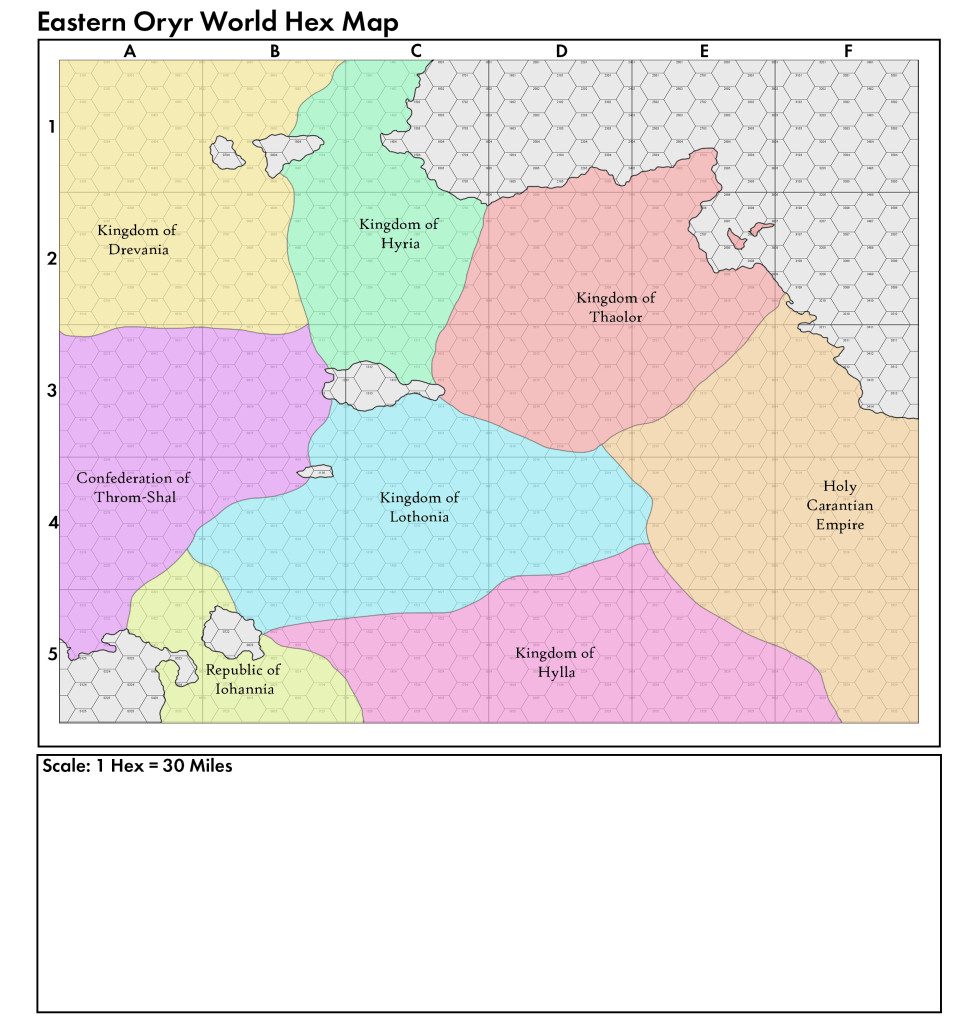
First, I used Azgaar’s World Generator until I got a continent of roughly the shape I wanted. Then, I opened the image I downloaded from the generator up into Photoshop and cropped it to fit into the hex area of the template that I created and will attach to this post. This produces a land area roughly the size of Central Europe. From there, I divided it up into countries based on what looked right off the map, this part is much more of an art form than a science.
So after deciding upon the countries, their names, and their borders. I chose one nation to focus on first. As a result, this series will follow the development of the Kingdom of Thaolor. Once the focus of my efforts was decided upon, it was time to move onto the next step, which is cropping down the map to focus just on the Kingdom of Thaolor and determining its demographics. Since the vibe I was going for here was Late/Post-Roman Britain before the Anglo-Saxon migrations, so the population density of this kingdom is about 40 people per square mile.
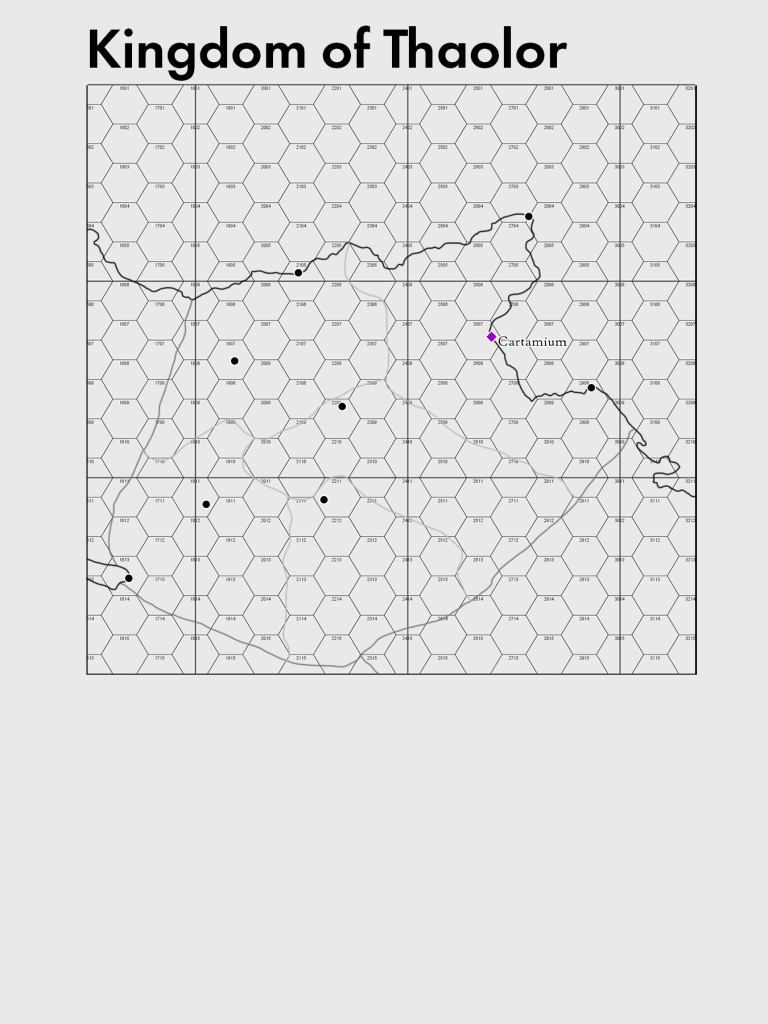
With that information determined we were ready to go over to Welsh Piper’s Medieval Demographics Online to figure out how many cities we need to place. Plugging in our population density, a history spanning about 1,200 years of inhabitation, and the knowledge that Thaolor occupies about 85,800 square miles (a little bigger than modern day Austria) we learn that we have one massive city of about 17,000 people and eight smaller cities of about 10,000 people each. We can skip naming most of these cities now, we will come back to that but we can name the capital just as guide. The result is the below map which will serve as an excellent guide as we move forward.
Next we open up the sector template (use the hexRegional_5mileScale template from the Welsh Piper temaplates) in hexographer (this is the template we are using to drill down to a 6 mile per hex scale) and begin to fill in the terrain using the process described in my Thoughts on Hexmapping Part 1 post. I’m going to start with Sector E2. Once we finish that we can begin to stitch them together in Photoshop, which will be a time consuming but worthwhile process.
I won’t pontificate for too long on the placement of rivers. It is possibly one of the most discussed subjects in the whole topic of producing maps for fantasy roleplaying games. I will therefore remain concise. It is recommended that you place rivers in ways that make good sense and set them up to flow downhill into larger bodies of water. Lake hexes (bodies of water that take up at least one whole 6 mile hex should have at least two rivers leading into them but feel free to exercise your own judgement.
Step 3: Placing Settlements
Now almost just as much ink has been spilled in the tabletop blogosphere about cities and settlements. The system that I’m about to describe here isn’t necessarily breaking new ground but I am going to be synthesizing several ideas in this system. The main things that I’m drawing upon are Medieval Demographics Made Easy, Traveller’s Universal World Profile, Welsh Piper’s Cities & Settlements article and Medieval Demographics online tool, and this article by Bat in the Attic about using the UWP in a fantasy context.
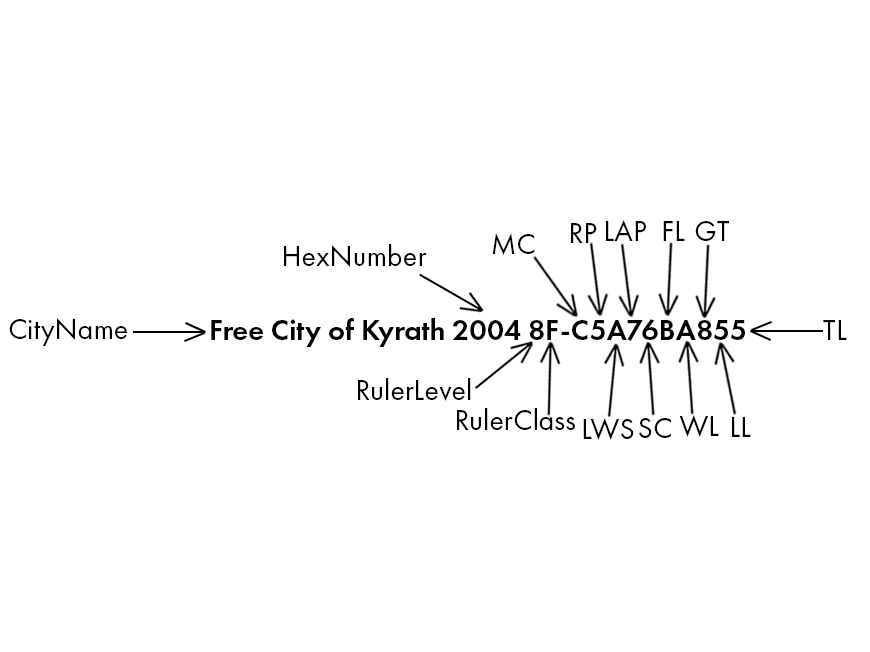
The Universal City Profile (UCP) The Universal City Profile, or UCP as I will call it from now on, is an alphanumeric code that is intended to portray a brush over of information on the hex map to make it into a more useful tool for running at the table. The UCP read as follows:
Resource Potential (RP) The Resource Potential score is determined by rolling 2d6-2 to produce a range of 0-10 (A). This represents how rich in non-agricultural resources the area the settlement is built on is.
Local Water Supply (LWS) The Local Water Supply score is determined by rolling 2d6-7 and adding or subtracting the appropriate modifiers to produce a range of 0-10 (A). Add +6 if the settlement is within 1 hex of a river. Add +4 if the settlement is within two hexes of a water hex. Add +2 if the settlement is in a forest hex. Subtract -1 if the settlement is in hill hex. Subtract -2 if the settlement is in a mountain hex. Subtract -6 if the settlement is in a desert hex. This value is automatically 10 if the settlement is in a swamp hex.
Local Agricultural Potential (LAP) The Local Agricultural Potential score is determined by rolling 2d6-7 and adding the Local Water Supply score to produce a range of 0-10 (A). This represents how fertile the farms and herds which are managed immediately outside the settlement and are used to feed the people of the settlement.
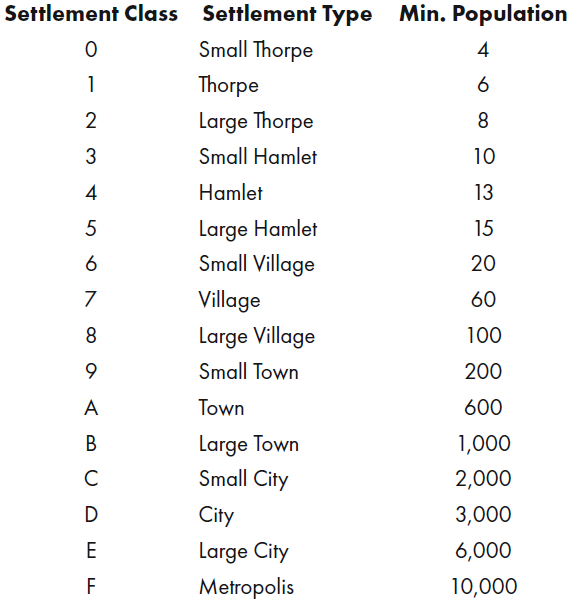
Population/Settlement Class (SC) The Settlement Class of a settlement is determined by rolling 2d6 and then adding the appropriate modifiers based on RP, LWS, and LAP, as well as its proximity to other settlements, as detailed below. This will produce a range of between 0 and 15 (F). The minimum population table is in units we will call families, which consists of 5 people.
If the settlement’s RP is 2 or less, subtract one. If the settlement’s LAP is 2 or less subtract one. If the settlement’s LAP is 3, 4, or 5, add one. If the settlement’s LAP is 6 or greater, add three. If the settlement’s LWS is 0, subtract two. If the settlement is adjacent to a settlement with a Settlement Class (SC) of C or higher, subtract six. If the settlement is within two hexes of a settlement with a SC of C or higher, subtract three. If the settlement is adjacent to a settlement with a SC of 9, A, or B, subtract four. If the settlement is within two hexes of a settlement with a SC of 9, A, or B, subtract two. If the settlement is adjacent to a settlement with a SC of 6, 7, or 8, subtract two. If the settlement is within two hexes of a settlement with a SC of 6, 7, or 8, subtract one.
Fortification Level (FL) This signifies what sort, if any, of fortifications (castles, keeps, etc.), that the ruler of the settlement lives in. This is determined by rolling 2d6 and adding the appropriate modifiers as detailed below.
If the SC of the settlement is C or higher, add six. If the SC of the settlement is 9, A, or B, add four. If the SC of the settlement is 6, 7, or 8, add two. If the SC of the settlement is 3, 4, or 5, subtract two. If the SC of the settlement is 2 or less subtract four.
A score of 12 or higher indicates a FL of A, which means that the settlement contains a full Castle (an internal Keep and surrounding curtain wall). A score of 11 indicates a FL of B, which means that the settlement contains a standalone Keep. A score of 10 indicates a FL of C, which means that the settlement contains a standalone stone Tower. A score of 9 indicates a FL of D, which means that the settlement contains a wooden Hall or Manor House. A score of 8 or less indicates a FL of X, which means that the settlement contains no such fortifications.
Wall Level (WL) This signifies what sort, if any, of wall or fence encircles and encloses the settlement. This is determined by rolling 2d6 and adding the appropriate modifiers as detailed below.
If the SC of the settlement is C or higher, add six. If the SC of the settlement is 9, A, or B, add four. If the SC of the settlement is 6, 7, or 8, add two. If the SC of the settlement is 3, 4, or 5, subtract two. If the SC of the settlement is 2 or less subtract four.
A score of 12 or higher indicates a WL of A, which means that the settlement has a high stone Curtain Wall. A score of 11 indicates a WL of B, which means that the settlement has a wooden Palisade. A score of 10 indicates a WL of C, which means that the settlement contains a low stone Fence. A score of 9 indicates a WL of D, which means that the settlement has a Hedge. A score of 8 or less indicates a WL of X, which means that the settlement has no such Wall or Fence.
Government Type (GT) This score indicates what sort of system of government that the settlement operates under. This is determined by rolling 2d6-7 and adding the settlement’s SC.
Government Type Table
Score
Type
0
Clan Patriarch/Matriarch
1
Council of Clan Elders
2
Aristocratic Oligarchy
3
Athenian Style Democracy
4
Temple Complex Rule
5
Aristocratic Republic
6
Feudal Noble
7
Colonial Charter
8
Bourgeois Republic
9
Centralized Bureaucratic Republic
10 (A)
Tyrant/Dictator
11 (B)
Petty King
12 (C)
Federation of Freemen’s Guilds
13 (D)
Theocratic Republic
14 (E)
Theocratic Dictatorship/Kingship
15 (F)
Inquisitorial Oligarchy
Law Level (LL) The Law Level (LL) of a settlement indicates how much the authority of the ruler interferes with the lives of its inhabitants, what sorts of weapons that PCs can carry in the settlement, and is used as a modifier on certain sorts of checks. It is determined by rolling 2d6-7 and adding the Government Type to produce a range of 0-10 (A).
A LL of between 0-3 means that PCs can carry any sorts of weapons openly in the street. A LL of 4-7 means that PCs can carry swords and daggers but cannot openly carry weapons of war (polearms, spears, hammers, etc). A Law Level of 8 or higher means that PCs may not lawfully carry any weapons other than daggers, which must not be carried openly.
Technology Level (TL) The Technology Level of a settlement indicates the level of technology that the settlement has access to and produces. For our purposes, this will always be 5, which indicates a level of technology consistent with the period between 1000 CE and 1300 CE.
The takes “D&D has a problem letting go of its wargaming past” or “tabletop roleplaying games emerged out of wargames” have been uttered online so many time that it would probably be impossible to count at this point. As an avid wargamer and ttrpg referee, I take a major issue with two parts of both of these takes. Firstly that tabletop roleplaying games ever stopped being wargames and secondly that it would be a bad thing if they were still or that they were at one point. My thesis here will be that D&D (and most ttrpgs besides certain branches like those derived from Apocalypse World) are as a matter of fact still a kind of wargame and that this is a good thing.
Firstly, and this isn’t really an argument but I will dive down into it in this paragraph anyways, wargames are just good fun. If you haven’t for whatever reason, I recommend trying out a wargame. Of course Warhammer dominates the market space but Parabellum’s Conquest or the ASOIAF wargame are both great for those who might want more grounded fantasy and a personal favorite of mine is Privateer Press’s Warmachine, which is for the Iron Kingdoms setting (as an aside the 3.5 Iron Kingdoms books are a favorite of mine that I still use in my 3rd edition campaigns). There is a great deal of fun to be had in an afternoon of wargaming with friends.
Secondly, and I think that this is more the argument that supports my loose thesis here, large amounts of roleplaying already take place in the playing of a wargame. You need to place yourself in the mindset which you do not regularly inhabit, that of a commander of armies. Furthermore, a lot (and I mean A LOT) of wargamers take playing to the lore, style, and identity of their chosen factions very seriously (one just needs to experience the ire that Warhammer players display at Games Workshop when they feel a rule doesn’t adequately express their faction’s style). They take great pains to paint models with minute details like rank insignia, squadron emblems, etc. Many even write up histories and service records for important miniatures and OCs that they have created in the settings and through play.
Many, many wargames over the years have even created campaign systems by which to track the service of units, advance both units and heroic characters, and provide context to individual matches. As a matter of fact, this is an old tradition in wargaming which proceeds roleplaying games (and is directly where the idea of campaigns and campaign records comes from). The original D&D rules originated, as we all now know, from Arneson’s Blackmoor table, which occupied a part of the map of the larger Castle & Crusade society. These are the sorts of systems and tendencies within wargaming that roleplaying games relied on to emerge in the first place.
Okay, so we have now established that the line between wargames and roleplaying games is fuzzy at best and there is a very clear through line from campaigns within wargames into the style of roleplaying games. But why is this a good thing? Well to put it simply, the average modern roleplaying game is an individuated, alienated experience. This only becomes more true as roleplaying games and roleplayers try to differentiate themselves as “not at all like” wargames and wargamers. Embracing this legacy and the through-lines between wargames and roleplaying games, or rather as I contend collapsing the borders that we have erected between the two hobbies, is the path to creating a truly social, collective hobby.
Sorry this got a bit rambly at spots, this is less an essay and more a collection of loosely formed thoughts that I delve into as I work on the final version of Bloodfall. Thanks for reading and I hope to have the final version of the Bloodfall Rules Compendium ready for launch by Christmas time.
Another slightly short product announcement post today! Our work on Ancestry Supplement 1: Dhamphir for 5th edition high fantasy roleplaying is up on DrivethruRPG! Check it out for a bloodsucking gothic horror fantasy ancestry.

 Red Lily Adventuring
